

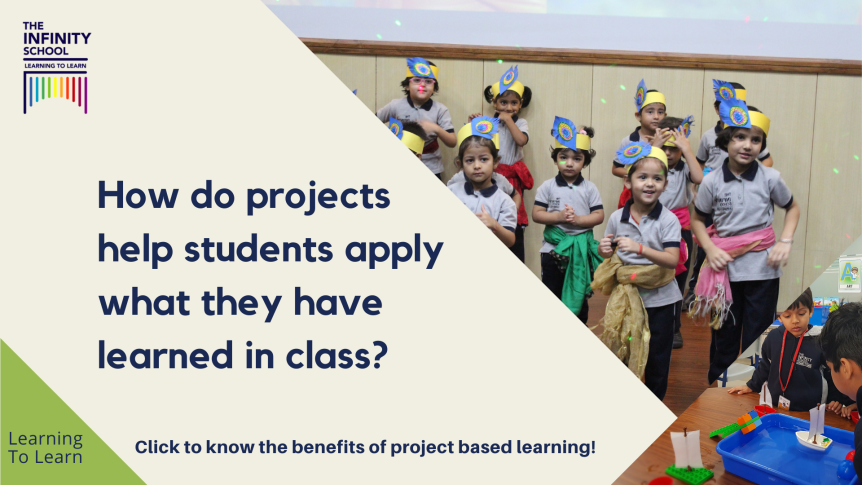
How do we help our children apply what they have learned? Merely having subject knowledge isn’t sufficient in today’s world. For tackling unimaginable challenges and complex problems, children need both foundational skills (like listening, observation, literacy) and 21st-century skills (like research, analysis, time management, decision-making). When kids get an opportunity to practise these skills in an environment mentored & supervised by caregivers, they start taking ownership of their tasks and learn to apply their knowledge and skills in the real world. Project based learning (PBL) in the classroom ensures that students acquire in-depth subject knowledge, learn its applications and practise it in real life. What is project based learning? What are the benefits of project based learning for students? How are the best schools in Noida Extension using it as a classroom tool to support 21st-century skill development in students? Read on to know the answers to these questions.
What Is Project Based Learning?
As the name suggests, the concept encourages students to make projects that depict what they have learned in class. It could be any type of project: short-term/long-term, online/offline, oral/written/typed, individual/group, etc. Surveys, PPTs, posters, essays, experiment records, working models, field trips, etc., are some popular project based learning examples implemented by educators. For instance, in the English class when reading Ruskin Bond books, teachers can ask students to re-design book covers, create posters summarising one of the chapters, or make a list of new words they’ve learned from the story and use them in their daily conversations. All these activities would involve students in analysing the story, doing research to gather information, organising facts, and presenting their findings while practising important skills like observation, time management, organisation, creative thinking, decision-making, problem-solving, etc.
The objective of project based learning is to blend real-life context, challenges, tools, and technology with classroom learning. The in-depth investigation and presentation of a topic related to the outside world (and demanding the child’s attention), allows them to become keen observers, logical thinkers, independent workers, and lifelong learners.
Keeping in mind the benefits of project based learning for students, teachers at The Infinity School—one of the best schools in Noida Extension, assign regular projects for students to improve their learning outcomes and academic performance.
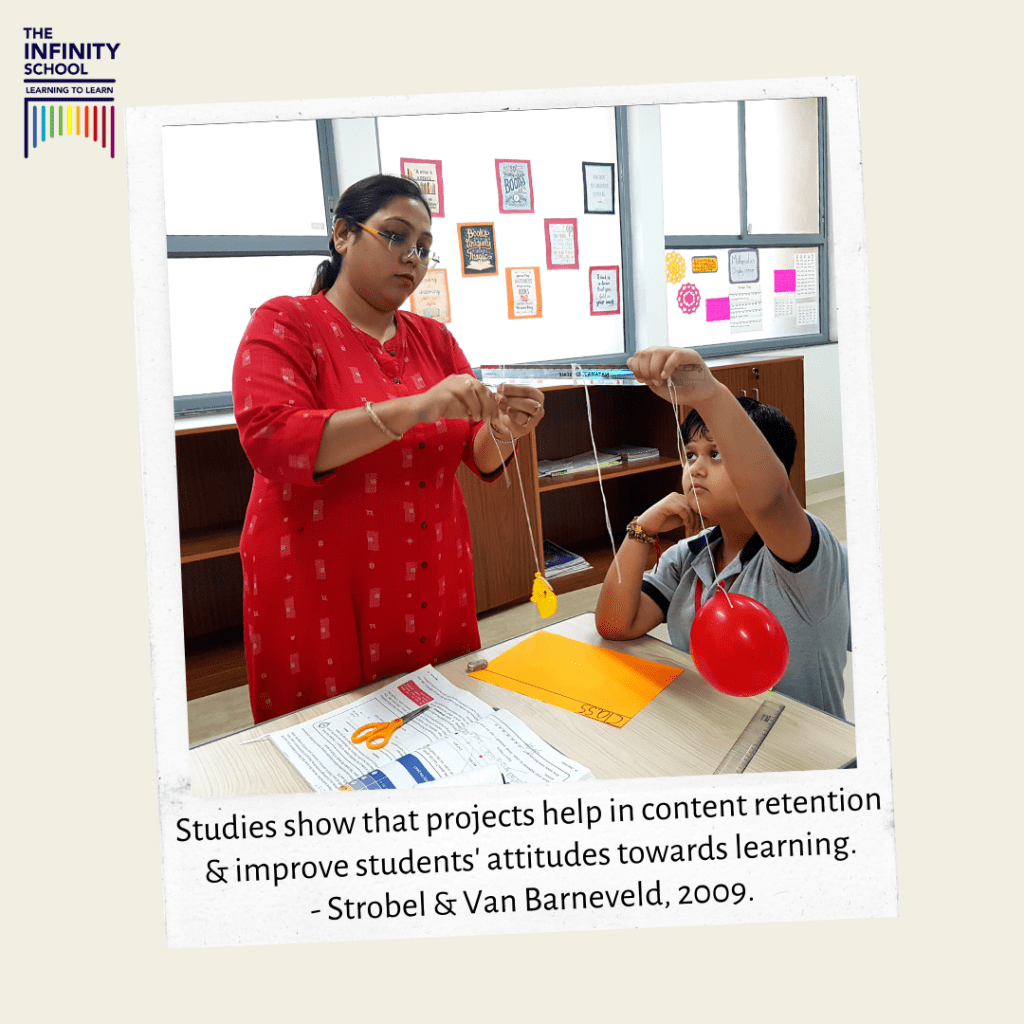
The Benefits Of Project Based Learning- Preparing Kids For Real World
- Cognitive Development
The process of making projects enhances students’ thinking abilities, as they sort their thoughts, think & debate, compare & arrange facts, weigh pros & cons, and form an opinion. By doing this more often, students learn to link previously-learned concepts, build a new knowledge base, thus, becoming active critical thinkers.
- Creative Boost
Projects inspire students to think outside the box. It’s a widely known fact that all children have different and unique learning styles. Project based learning acknowledges these differences and allows students to make decisions regarding data presentation. Children exercise the autonomy to use tools, technologies & areas of their interest. They explore multiple options in the process of researching and communicating results. This enhances their imagination, visualisation, communication skills, and cross-cultural understanding.
- Student Leadership
One of the major benefits of project based learning is that it supports student leadership. Working in groups and having discussions with peers and teachers introduce them to different perspectives. Kids begin to understand their strengths & flaws and learn the value of teamwork, dedication, commitment, goal setting, task delivery, etc. Moreover, children gain an understanding of how, when and what tool to use, thus, taking ownership of their job.

- Better Engagement & Retention
When children are creatively engaged in different projects, they enjoy what they’re doing, overcome their weaknesses, and utilise their strengths to achieve growth. It makes the learning process enjoyable and stimulating. Both students & teachers get a chance to break away from conventional learning practices. While teachers get to introduce innovative topics and ideas for project, students could use this opportunity to share ideas with their peers/family and voice their opinions through their work.
- Assessment & Feedback
Allowing students to pursue their creative interests through projects creates multiple assessment opportunities for teachers. Through projects, they get to learn about individual potential, capabilities, interests, weaknesses and strengths. Teachers can assist students in mastering their interests and exploring other learning styles. By evaluating projects, teachers can give feedback on the child’s efforts and progress. It allows them to communicate their feedback in a progressive & meaningful manner, and they could help students overcome learning gaps & challenges.
Project based learning is a comprehensive classroom learning strategy that positively influences a student’s personality by developing necessary skills and ensuring personal growth.
Being one of the best schools in Noida Extension, The Infinity School has always believed that project based learning and other student-led initiatives uniquely shape young minds. Inside our thinkrooms, teachers create multiple opportunities for students to exercise leadership in different contexts while honing 21st-century skills like collaboration, discipline, vision, communication, conflict resolution, adaptability, etc. Anubhuti (learner’s exhibition) and the school magazine Anant Anubhav are a few initiatives independently led and organised by students under the supervision and mentorship of teachers & The Infinity School management to encourage student leadership, independent thinking and lifelong learning.
 THE INFINITY SCHOOL