

Ever wondered why people still listen to Raag Hindustani, Alapana & Niraval? Why they cherish classics by Beethoven, Mozart, Bismillah Khan, or Ravi Shankar? Read on to find answers…
Music is an integral part of all cultures and societies. We are born with the innate ability to listen, express, sing & play music. When children are exposed to classical music repertoire in the starting years, they cultivate good socio-emotional skills. Exposing kids to soft classical music in early childhood develops a lifelong appreciation for other musical forms when they grow up (as per researchers at the London University’s Institute of Education).
Nearly all K12 schools and music academies follow a somewhat similar procedure for teaching music and other performing arts. Structure, pedagogy & teaching approaches that distinguish both are important for delivering a meaningful learning experience.
When music is learned through active experiences, students not just listen but also respond to, create, perform, and understand music.
Harnessing The 3 Benefits Of Music For Overall Child Development
- Active Listening Skills
- Critical Thinking
- Emotional Intelligence
1- ACTIVE LISTENING:
It is the key step in any standard music education. Students experience different sounds, genres, languages, and traditions by attentively listening to musical performances. Listening skills are nurtured through musical means, like playing different musical instruments, hearing and identifying different natural sounds, etc.
Exposure to global and local musical compositions gives them insight into the role of music & dance in different cultures. With good listening skills, children learn to follow instructions, communicate better, and are more observant of their surroundings.
2- CRITICAL THINKING:
Critical thinking is one of the most used terms in the education industry today. Nearly all K12 schools claim to support this skill through a music curriculum. But does learning music develop critical thinking abilities in children? Yes!
Creating music develops critical thinking, innate creativity, social awareness, psychomotor skills, moral & cultural values, thus, resulting in holistic child development.
Music is fodder for the soul. For children to learn music, they must first understand the language of music, and also its fundamental building blocks—musical elements, concepts & moods (Ras).
They’re best taught through daily musical experiences & involve the translation of lyrics into beats and rhythm. Musicians learn to make note-to-beat, text-to-text, text-to-note, text-to-self, and word-to-world connections at each step—all of which require the application of critical thinking skills.
Musical knowledge developed through critical thinking helps learners recall, process, conceptualise, and create music. With regular practice, students begin to draw relevant connections between chords, tunes, notes, pitch, volume, airspeed, etc. They learn to balance different elements to create musical compositions.
Advanced critical thinking skills leads to better decisions and quick problem-solving.
3- EMOTIONAL INTELLIGENCE:
Musical performances (like singing, playing a musical instrument, dancing to a song, etc.) build an instant connection to music. It enables them to recognise, understand & express different emotions, ideas, and thoughts.
Music creates the platform to understand emotions, organise ideas, reflect on their compositions & respond to their peers’ perspectives in a better manner.
Emotionally intelligent children develop many core values and 21st-century skills, like resilience, perseverance, respect, harmony, care, collaboration, integrity, etc., that are essential for surviving amidst competition.
Structured Music Curriculum: Focus On Early Childhood Development
If you don’t eat well, will you have enough strength to sing higher notes? If you aren’t physically active, will you be able to perform? Probably not! Practising music every day allows children to explore it as a subject. Eventually, they learn to connect it to other subjects.
A structured music curriculum is where music teachers deliver step-by-step, root to top knowledge at regular intervals. Educators plan lessons to engage children in a variety of musical experiences. This provides a sufficient scaffold for kids to acquire and practise music skills on their own. Probably that’s why people still prefer to listen to classical music and learn music from personal tutors and gurus belonging to acclaimed gharanas.
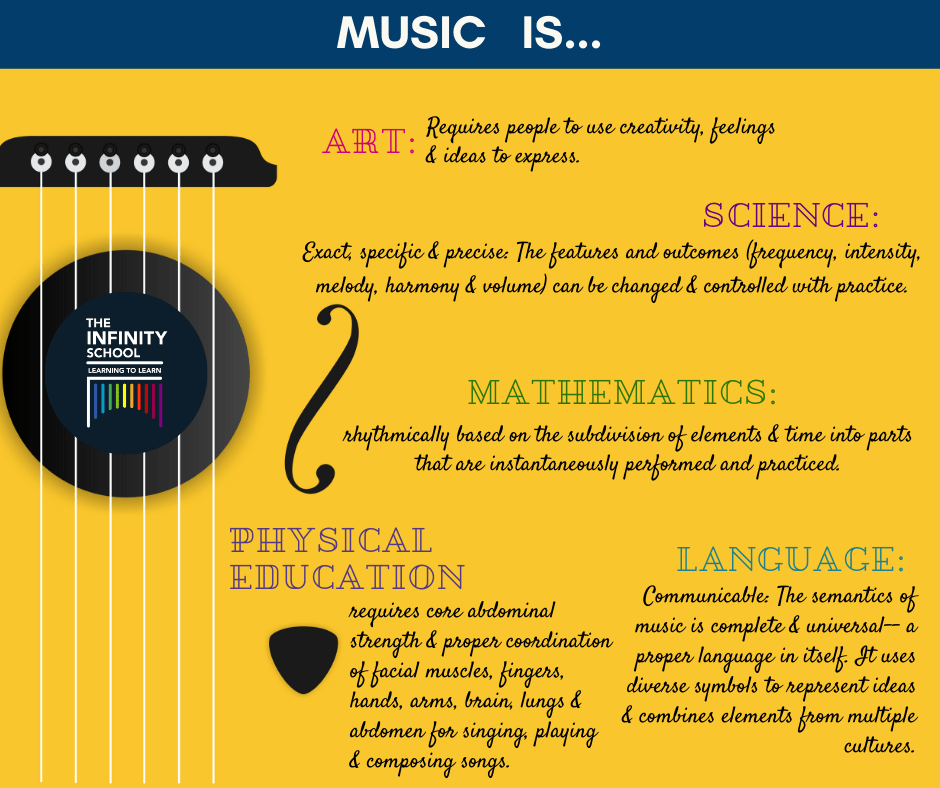
Some Effective Ways Of Teaching Music In Schools—
- Active questioning
- Listening & playing different musical compositions everyday
- Combining music with other kinaesthetic experiences. E.g., Graphical (movies & video), Visual (dance dramas), Physical movement (cheer leading, music-based games), etc.
- Collaborative group projects (like group performances, drama, song-writing competition, etc.)
Musical assessments (written assignments, stage performances, reflection journals, etc.) play an equally important role. Regularly conducting assessments for learning helps students understand their strengths, deficiencies, and learning gaps.
Inside our music room, learning experiences are tailored to develop the musical ability of children, in association with our music partner Sangeet 4 All Academy. When kids learn about musicians, compositions, music, and its role in different cultures, their musical understanding is contextualised and deepened to foster lifelong learning.
 THE INFINITY SCHOOL